
Review · CITY TOURS
Small Daily Tours in Beirut City
Beirut tells its story in layers. This three-hour introduction links seaside views, war memories, religious landmarks, and Roman ruins in one compact outing. I like the hotel pickup and drop-off anywhere in Beirut, which removes much of the morning fuss, and I like the small maximum of 15 people, a better setup than a large coach. The main drawback is the brisk schedule: with many stops packed into roughly three hours, you will see the city’s key sights but may not have much time inside each one.
The tour uses an air-conditioned vehicle and an English-speaking driver or tour leader. That matters in Beirut, where downtown sights are spread between the coast and central districts. I would treat this as an orientation tour, not a full museum day or a slow walking tour. It gives you the city’s broad outline, then leaves room for you to return to the places that catch your interest.
In This Review
- At a glance: what this Beirut tour gives you
- Why this is a useful first look at Beirut
- Raouche Rocks and the Corniche
- Zaitunay Bay and Beirut’s modern waterfront
- Mohammad Al-Amin Mosque and Martyrs’ Square
- Al-Omari Mosque and Saint George Cathedral
- Martyrs’ Square and Place de l’Étoile
- Roman Berytus Baths: Beirut beneath the modern city
- Transport, group size, and the pace
- Who should book it?
- Should you book this Beirut city tour?
- FAQ
- How long does the Beirut city tour last?
- Is hotel pickup included?
- What transportation is used?
- How many people can join the tour?
- Is lunch included?
- Is the National Museum of Beirut included?
At a glance: what this Beirut tour gives you
- Raouche Rocks first: Begin at Beirut’s famous western tip, with about 10 minutes at Pigeon Rock and views across the Mediterranean.
- A sharp look at modern Beirut: The route includes the Corniche, Zaitunay Bay, and the abandoned Holiday Inn, three very different pieces of the city’s recent identity.
- Religious landmarks close together: See the Mohammad Al-Amin Mosque, Al-Omari Mosque, and Saint George Greek Orthodox Cathedral in the downtown area.
- Ottoman and Roman history: Martyrs’ Square, Place de l’Étoile, and the Roman baths add political and ancient context.
- Useful transport for a short visit: Air conditioning, hotel transfers, and an English-speaking driver let you cover more ground without arranging several taxis.
- A small-group limit: The group is capped at 15 people, which should make questions and stop arrangements easier than on a large bus.
Why this is a useful first look at Beirut
Beirut is not a city you understand from one postcard view. Its seafront, restored downtown, religious buildings, ancient remains, and war-damaged structures sit close together, but they tell very different stories. This tour works because it places those contrasts side by side.
You begin beside the sea, move through the central city, and finish among Roman remains. Along the way, you see grand new construction, old places of worship, a square tied to Lebanese national memory, and a damaged hotel left as a reminder of the civil war. That is a lot of context in a short morning.
I would choose this outing early in a Beirut stay. The pickup starts at 8:30 am, and the compact route can help you understand where the waterfront and downtown fit together. Afterward, you can decide which areas deserve a longer return visit.
The listed price is $65 per person. That is reasonable if you value door-to-door transport and a guide for a short introduction. It is less compelling if you are already comfortable arranging taxis and mainly want one or two sights. The value comes from the combination of transport, commentary, and a carefully packed route rather than from long visits at individual attractions.
A few more trips out of Beirut worth a look
- Guided Small-Group Tour to Baalbek, Anjar and Ksara with Lunch
★ 5.0 · 511 reviews - Guided Small-Group Tour to Jeita, Harissa, Byblos with Lunch
★ 5.0 · 361 reviews - Paragliding Trip Over Lebanon – Jounieh Bay
★ 5.0 · 257 reviews
Raouche Rocks and the Corniche
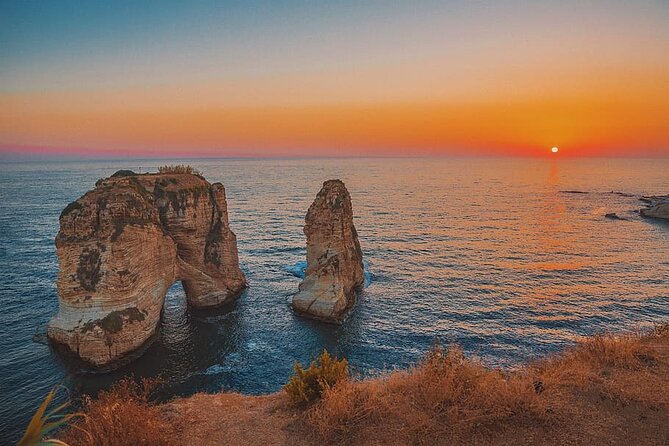
Raouche Rocks, also called Pigeon Rock or the Rock of Raouché, is the natural opening to the tour. The two large formations sit at Beirut’s westernmost tip, rising from the sea like rocky sentries. You have about 10 minutes here, and admission is free.
That short stop is enough for a look and photographs, but not for a relaxed seaside outing. If you want to sit by the water or explore the promenade at length, plan to return independently. The value here is orientation: you immediately see Beirut’s relationship with the Mediterranean.
The route also passes along Al Manara Corniche, the city’s best-known seaside promenade. It stretches from the Ramlet al Bayda area toward the Saint George marina and is lined with palm trees. From the road, you can take in the Mediterranean, Pigeon Rock, and views toward Mount Lebanon on the eastern side.
Because this is a vehicle-based tour, do not expect an extended walk along the Corniche. You are getting a moving introduction to the shore, with Raouche Rocks as the main photo stop.
Zaitunay Bay and Beirut’s modern waterfront
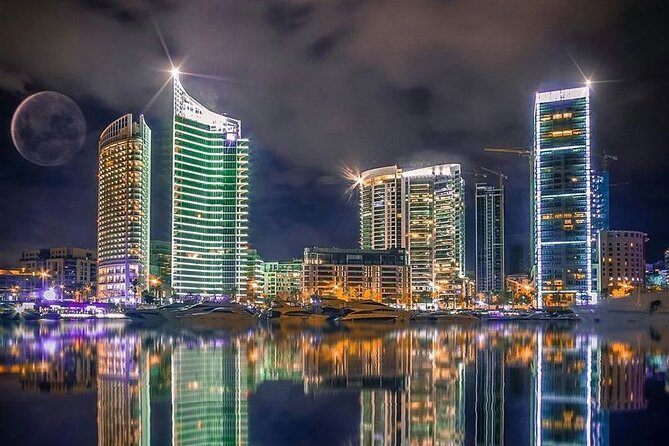
Zaitunay Bay offers a very different coastal picture. This newer waterfront promenade has shops and restaurants, and it presents Beirut as a leisure destination rather than an ancient port or a war-scarred capital.
The contrast is useful. In a few minutes, you move from natural rock formations to a planned marina setting. I like that the route does not present Beirut as only an old city. The modern waterfront is part of the city’s current life, even if this stop is likely more of a passing look than a long visit.
The same is true of the abandoned Holiday Inn. Built between 1971 and 1974, when Beirut’s economy was booming, it became a major position during the Lebanese Civil War. The Battle of the Hotels involved fighting over several luxury hotels, including the Holiday Inn and the Phoenicia.
The building remains abandoned and largely untouched decades after the war. It is not a polished sightseeing stop, and that is precisely why it matters. The bullet-scarred structure gives a physical presence to a period that can otherwise feel distant in a city tour. You should expect a brief exterior view, not entry into the hotel.
Mohammad Al-Amin Mosque and Martyrs’ Square
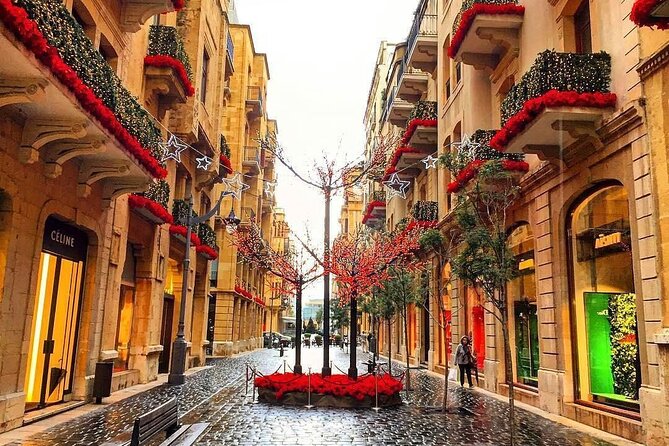
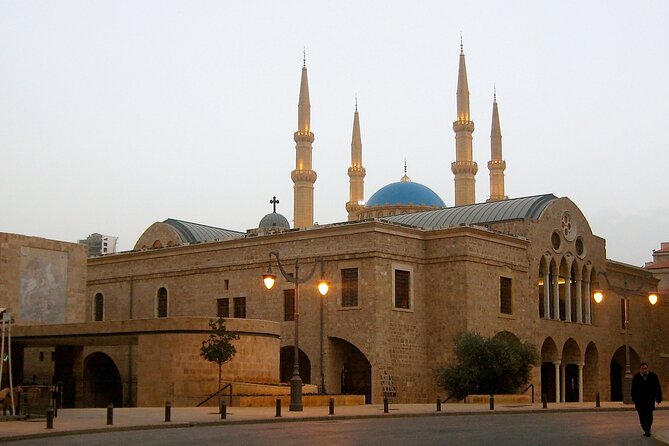
Downtown Beirut brings the tour into a concentrated area of major landmarks. The Mohammad Al-Amin Mosque, often called the Blue Mosque, is Lebanon’s largest mosque. It opened in 2008 and is easy to recognize by its light blue tiled domes, large arches, and four minarets that rise 65 meters.
You have about 10 minutes here, with no admission charge listed. That is enough to appreciate the building’s scale and exterior design. If interior access matters to you, ask the tour leader about the arrangement and appropriate visitor expectations, since the supplied details do not promise an interior visit.
The mosque sits near Martyrs’ Square, one of Beirut’s most important public spaces. The square was historically known as Al Burj or Place des Cannons. Its current name recalls the Lebanese nationalists executed there by Ottoman authorities on May 6, 1916, during World War I.
This is a place where a short explanation adds real value. Without context, it may look like another downtown plaza. With context, it becomes a marker of political memory and national identity. The stop is listed for about 10 minutes, so listen closely and use the time for a quick look around.
A different side of Lebanon altogether:
- First Paragliding Club in Lebanon – Since 1992
★ 5.0 · 193 reviews - Anjar, Baalbek & Ksara Day Trip – With Lunch (4G on Board)
★ 4.5 · 181 reviews - Jeita Grotto – Harissa – Byblos Trip
★ 5.0 · 169 reviews - Byblos, Jeita Grotto & Harissa Day Trip -With Lunch (4G on Board)
★ 4.5 · 145 reviews
Al-Omari Mosque and Saint George Cathedral
The Al-Omari Grand Mosque offers a much older layer of Beirut’s story. Its origins are linked to the age of Omar Bin El Khattab in 635 AD. Crusaders later converted it into the Church of Saint John, and the Mamluks returned it to use as the city’s Grand Mosque in 1291.
The building was damaged during the civil war, with restoration completed in 2004. That sequence tells you something important about Beirut: a single religious site can reflect early Islamic rule, the Crusades, Mamluk power, modern conflict, and reconstruction.
The scheduled stop is about 10 minutes, so you will need to focus on the exterior and the guide’s explanation. It is a good place to ask how the city’s religious buildings changed over time, especially because the next stop adds a Christian counterpart.
Saint George Greek Orthodox Cathedral is the seat of the Greek Orthodox Metropolitan bishop of Beirut and its dependencies. It is also described as the oldest church in the city and one of the oldest in the region. The first Christian temple at this location dates to the mid-sixth century and is linked with Beirut’s famous Law School.
Seeing the mosque and cathedral within the same downtown circuit is one of the tour’s strongest features. You are not just ticking off monuments. You are seeing how different faiths and historical periods share the same compact city center.
Martyrs’ Square and Place de l’Étoile
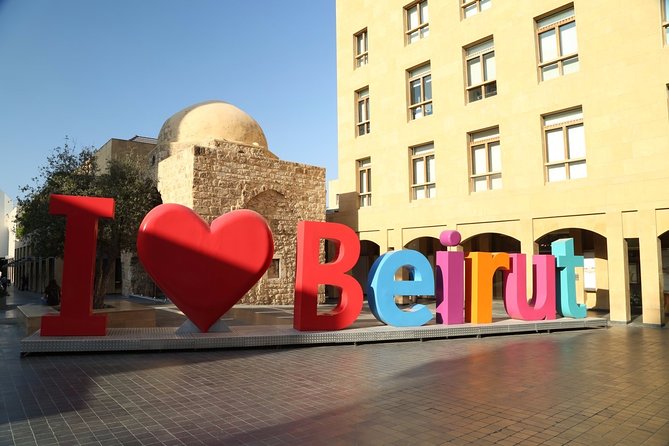
Martyrs’ Square and Place de l’Étoile help explain Beirut’s civic center. Martyrs’ Square carries the weight of the 1916 executions, while Place de l’Étoile functions as the central square of the downtown area.
Place de l’Étoile is home to the Lebanese Parliament and nearby buildings, two cathedrals, a museum, cafés, and restaurants. Its best-known feature is the four-faced Rolex clock from the 1930s. The clock and the surrounding architecture have become recognizable symbols of Beirut.
Again, the tour gives you roughly 10 minutes at the stop. That is enough to identify the landmarks and understand the layout, but not enough for a leisurely café break or detailed architectural study. If downtown interests you, this is an area worth revisiting on foot after the tour.
The compact schedule can feel hurried here, especially because the central district contains several sights close together. Still, having the driver move you between the coastal and downtown areas saves time during a three-hour experience.
Roman Berytus Baths: Beirut beneath the modern city
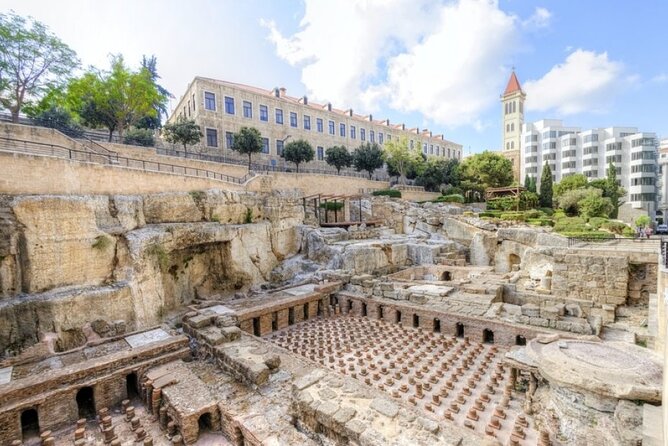
The Roman baths are the archaeological payoff of the downtown route. The remains were discovered in 1968 and 1969 and underwent major renovation in the mid-1990s. Ancient Berytus had four major bath complexes, with the first created in the early first century under Augustus.
A major earthquake in 551 AD destroyed the baths. Today, the site is an outdoor archaeological area, and one of the bath spaces is used for artistic performances and concerts. That modern use helps you picture the remains as part of living Beirut rather than a sealed-off relic.
The stop is listed at about 10 minutes, with free admission. You will not get a long archaeological visit in that time, but the ruins make an important final point: Beirut is built over a very old city. The Roman remains are close to the modern streets, offices, and religious buildings, making the city’s layered past unusually easy to see.
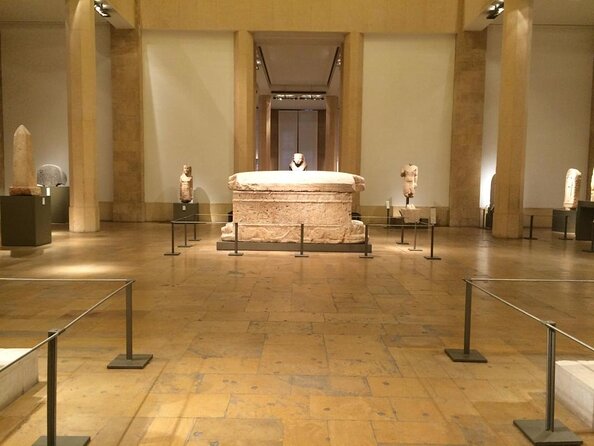
The tour overview also includes admission to the National Museum of Beirut. Since the detailed stop schedule does not assign a separate visit time to the museum, confirm how it fits into your specific departure. This matters because three hours is already tightly filled by the listed stops. If the museum is a priority, ask whether the route includes entry, an exterior stop, or a visit arranged within the timing.
Transport, group size, and the pace
The air-conditioned vehicle is a practical advantage, especially when the route moves from Raouche to downtown. You avoid arranging separate rides and can keep your attention on the city instead of on directions and parking.
Hotel pickup and drop-off are included from anywhere in Beirut. That is particularly useful for a short morning tour because you do not lose time getting to a central meeting point. The start time is 8:30 am.
The group limit is 15 people. This is small enough to feel more personal than a full-size sightseeing coach, though it is not the same as a private tour. The experience is described as using a private vehicle with an English-speaking driver, so clarify at booking whether your departure is private or shared within the 15-person limit.
The available rating is 4.5 from two submitted ratings, but the written comments attached to the supplied information concern Tripoli outings rather than this Beirut route. They do not provide a reliable account of every Beirut stop. Still, they offer one useful clue about the service style: one driver is praised for perfect English, punctual pickup, and helping a solo female visitor feel comfortable. Another guide named Imad is praised for collecting a solo visitor exactly on time and for his clear love of Lebanon and its history.
Those comments should not be treated as a guarantee that Imad will lead your Beirut tour, but you can request him if the provider allows guide requests. Punctual pickup and an English-speaking guide are especially valuable when the route contains many short stops.
Who should book it?
I would recommend this tour to a first-time visitor with only one morning in Beirut, anyone who wants an organized introduction, and solo visitors who prefer included transport. It also suits people who want to see both famous coastal views and central historical sites without planning a route from scratch.
It is a good fit if you enjoy seeing many landmarks and then choosing where to spend more time later. The Holiday Inn, Roman baths, mosques, cathedral, and waterfront each deserve more than a few minutes, but the tour helps you decide which ones deserve a return visit.
I would choose something else if you want long museum time, extended walks, or detailed access to religious interiors. The three-hour schedule is an overview by design. You are paying for range and convenience, not an unhurried study of every monument.
Free cancellation is available up to 24 hours before the 8:30 am start for a full refund. Changes or cancellations made less than 24 hours before departure are not accepted for a refund, and the cut-off uses Beirut local time.
Should you book this Beirut city tour?
Book it if you want to get your bearings quickly and prefer a vehicle, hotel transfers, and an English-speaking guide. The mix of sea views, religious landmarks, Ottoman-era memory, civil war history, and Roman remains gives you a thoughtful first outline of Beirut rather than a simple parade of monuments.
Before paying, confirm the exact role of the National Museum in the three-hour schedule and ask whether your departure is private or shared. If those details suit you, $65 is fair for a compact, transport-inclusive introduction. Just keep your expectations realistic: you will see a lot, but the short stops are meant to point you toward Beirut, not finish the city in one morning.
FAQ
How long does the Beirut city tour last?
The tour lasts approximately three hours and starts at 8:30 am.
Is hotel pickup included?
Yes. Hotel pickup and drop-off are included from anywhere in Beirut.
What transportation is used?
The tour uses an air-conditioned vehicle, with an English-speaking driver or tour leader.
How many people can join the tour?
The maximum group size is 15 people.
Is lunch included?
No. Lunch is not included in the tour price.
Is the National Museum of Beirut included?
Admission tickets to the National Museum of Beirut are included in the tour overview. The detailed timing does not list a separate museum stop, so confirm how the museum visit fits into your departure schedule.
Newest Beirut reviews
- Wine Tasting Tour★ 5.0 · 2 reviews
- Lebanon’s Treasures: Jeita Grotto and Harissa Private Tour★ 5.0 · 2 reviews
- Journey Through Time: Half-Day Private Tour to Baalbek★ 5.0 · 3 reviews
- Traveling Spoon Lebanese Mezze Private Online Cooking Class★ 5.0 · 4 reviews
- Wine Tasting and Culture★ 5.0 · 3 reviews
- Small Group Tour to Baalbek, Anjar & Ksara with Hotel pickup★ 5.0 · 2 reviews
- Small Group Tours to Jeita Grotto and Byblos with tickets★ 5.0 · 3 reviews
- Small-Group Tour with Lunch to Baalbek, Anjar and Ksara★ 5.0 · 3 reviews
City Tours, compared.
PRIVATE city Tour of authentic Tripoli and vibrant Batroun
Read our review →
PRIVATE tour to Jeita Grottos, Harissa Shrine & Byblos City
Read our review →
Private Beirut City Tour with Boat Ride at Raouche Rock
Read our review →
Browse the lists this tour appears in