
Review · TRIPOLI TOURS
Guided Full-Day Private Trip to Tripoli from Beirut
Tripoli rewards patient curiosity. This private day trip makes Lebanon’s second city much easier to explore, with pickup from your central Beirut address and a guide handling the complicated driving and route. I especially like the chance to see both Tripoli’s grand medieval buildings and its working souks, plus the stop at Hallab 1881 for famous Lebanese sweets. The private format is another strong point, since your group can move at its own pace.
The main thing to consider is the length. At eight to nine hours, this is a full day, and the many short stops can feel busy if you prefer slow, unstructured wandering. Lunch is not included, and the tour price is listed at $100 per person, although group discounts may be available.
In This Review
- Key points to know before booking
- Why Tripoli makes a worthwhile day from Beirut
- The Citadel Saint Gilles and Tripoli’s high view
- Al Mansouri Mosque and the marks of two traditions
- Taynal Mosque and reused Roman columns
- Entering the souks through Souk Al-Harajb
- Soap, hammams, and old urban life
- Oscar Niemeyer’s unfinished fair in Tripoli
- Hallab 1881 and the sweet side of Tripoli
- El Mina Port and the coastal finish
- The guide can make the long day work
- Who should book this Tripoli day trip?
- Should you book it?
- FAQ
- Where does the Tripoli tour begin and end?
- How long does the experience last?
- Is this a private tour?
- Is transportation included?
- Is a professional guide included?
- Are entrance fees included?
- Is lunch included?
- What is the price?
- Can I cancel for a full refund?
Key points to know before booking
- Private transport from Beirut: Pickup and drop-off at your downtown address remove the hassle of navigating Lebanon’s traffic and road blocks.
- A rare mix of sights: You see a Crusader citadel, Mamluk mosques, medieval souks, Ottoman-era khans, old hammams, a modernist fairground, and the port.
- Excellent guide support: Rita and Pierre are specifically praised for leading well-managed tours, with Pierre receiving special credit for making the long day feel manageable.
- Entrance fees are covered: The Citadel Saint Gilles admission is included, while most other listed stops are free to enter.
- Tripoli beyond the monuments: The tour takes you through tailors’ khans, the historic soap market, functioning and abandoned bathhouses, and the coastal district of El Mina.
- Best for curious first-time visitors: You get a broad introduction to Tripoli in one day, though the schedule leaves limited time for lingering at each small stop.
Why Tripoli makes a worthwhile day from Beirut
Tripoli sits about 50 miles, or 80 kilometers, north-northeast of Beirut on the Mediterranean coast. It is one of Lebanon’s oldest cities, with roots reaching back to the Phoenician period. The city’s story is not confined to one era. Crusader, Mamluk, Ottoman, and modern Lebanese influences all appear within a relatively compact area.
That layering is what makes the trip valuable. You are not simply ticking off a castle and two mosques. You are watching a city change character from hilltop fortress to old commercial quarter, then from historic center to port and modernist cultural site.
Driving yourself would make this day harder. The tour includes a private, air-conditioned vehicle and pickup from your central Beirut accommodation, so you can spend the journey looking out the window or resting instead of worrying about directions. The private arrangement also means you are not tied to the pace of a large coach group.
At $100 per person, the value depends partly on your group size. For a couple, it is a fairly substantial day-trip price, but it includes private transportation, a tour leader, a professional guide, hotel pickup, hotel drop-off, and the Citadel entrance. For a small group, the private vehicle and direct transfers make the price easier to justify, especially if group discounts apply.
More trips north to Tripoli:
- PRIVATE city Tour of authentic Tripoli and vibrant Batroun
★ 5.0 · 51 reviews - Guided Small-Group Tour to Tripoli and Batroun with Lunch
★ 5.0 · 16 reviews - Tripoli City Lebanon Trip
★ 5.0 · 7 reviews
The Citadel Saint Gilles and Tripoli’s high view
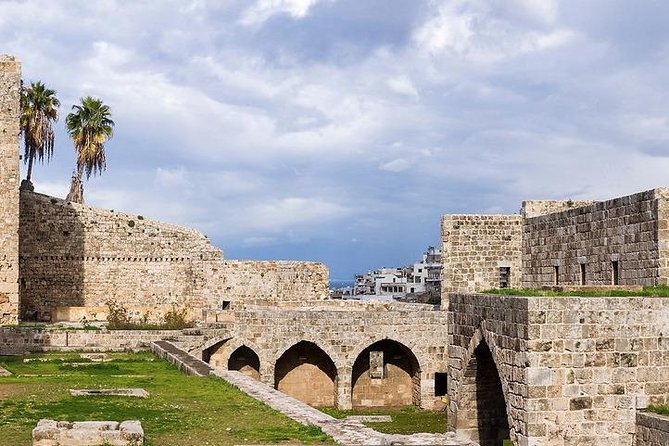
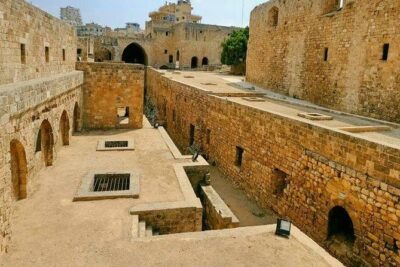
The Citadel Saint Gilles, also called Qal’at Sinjil, is the natural opening act. It rises above Tripoli and gives you a useful sense of the city’s shape before you enter the older quarters.
The fortress is large, about 140 meters long and 70 meters wide. Its current form is the result of many building periods. The site includes an octagonal Fatimid structure later adapted into a church by the Crusaders, Crusader work from the 12th and 13th centuries, Mamluk additions from the 14th century, and Ottoman changes from the 16th century.
That mixture makes the Citadel more interesting than a single-period castle. Look for the way later builders reused earlier structures. The fortress was also extensively restored under Mustafa Barbar Agha, Tripoli’s governor at the beginning of the 19th century, so what you see is both an old military site and a later act of preservation.
You get about 30 minutes here. That is enough to take in the main structures and views, but not enough for a slow architectural study. If castles are your main interest, you may wish the stop were longer. Still, the overview is useful, and admission is included.
Al Mansouri Mosque and the marks of two traditions
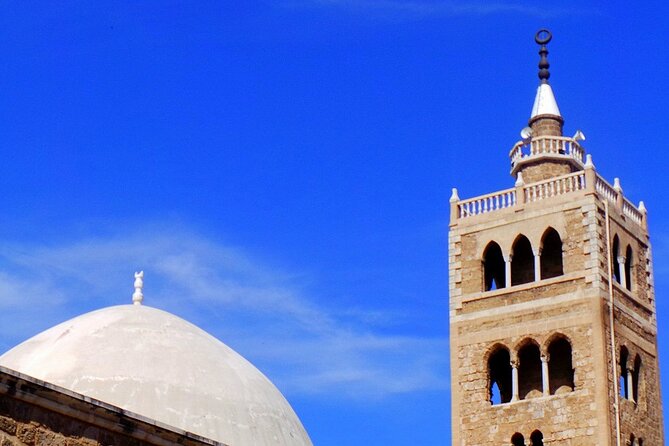
The Al Mansouri Great Mosque dates from 1294 to 1315 and was built over the remains of the Crusader cathedral of St. Mary of the Tower. Its courtyard leads to a vaulted prayer hall, where pieces of the earlier Western structure remain visible.
The northern entrance and the Lombard-style bell tower are especially notable. The bell tower was later converted into a minaret, a small but revealing example of how Tripoli’s religious buildings changed hands and functions over time.
The mosque also contains foundation plaques and decrees. These are more than decoration. They offer clues about the Mamluk period and daily civic life. You have only about 15 minutes here, so listen closely to the guide and focus on the main architectural details rather than trying to inspect every inscription.
The visit is free, and the stop pairs well with the Citadel. The fortress explains Tripoli’s military importance from above, while Al Mansouri shows how power and religion were expressed within the city itself.
Taynal Mosque and reused Roman columns
The Taynal Mosque was built in 1336 by Saif Ed-Dine Taynâl on the site of a ruined Crusader church. Its adjoining domed mausoleum holds the founder’s tomb.
The most arresting detail is inside the first prayer hall, where two rows of granite columns with late Roman capitals were reused. These columns are a reminder that Tripoli’s builders did not always start from scratch. Older stones and forms were folded into new religious buildings.
The entrance to the second prayer hall is also important. It is described as a distinctive example of Mamluk architectural decoration in Tripoli. You get around 15 minutes here, so this is another place where a good guide adds real value. Without context, the columns may look like attractive old stonework. With context, they become evidence of the city’s long building history.
A few more trips out of Beirut worth a look
- Guided Private Full Day Tour to Baalbek, Anjar and Chateau Ksara
★ 5.0 · 60 reviews - Jeita Grotto, Byblos and Harissa Full-Day Tour from Beirut
★ 5.0 · 23 reviews - Full-Day Private Tour to Jeita Grotto, Harissa and Byblos
★ 5.0 · 20 reviews - Beirut Full Day Walking Tour
★ 5.0 · 14 reviews
Entering the souks through Souk Al-Harajb
The souks are likely to be the most atmospheric part of the day. Tripoli has nine named souks, including Attareen, Bazerkan, Haddadin, Haraj, Kameh, Koundarjiyeh, Nahhasin, Samak, and Sayyaghin. There is also a food souk with fresh produce, meat, fish, and other daily goods.
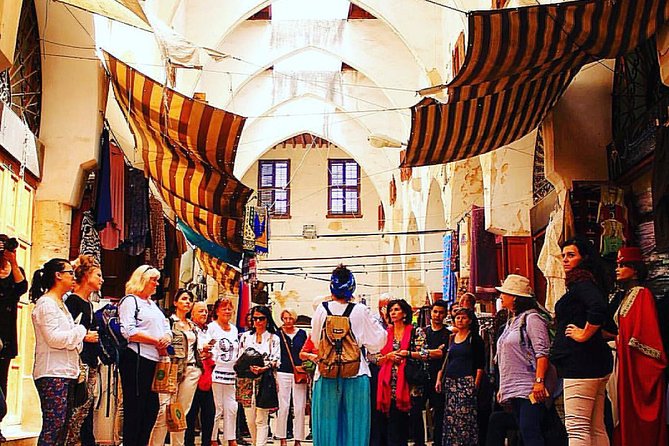
Souk Al-Harajb gives you a taste of this old commercial network. The passageways are narrow, the alleys branch off in unexpected directions, and each area has traditionally been linked to particular trades. This is not a polished shopping mall built for sightseeing. It is a working part of the old city.
You have about 30 minutes for the souk visit. That is enough to look around and get a feel for the streets, but you should not expect a leisurely shopping session. The best approach is to stay alert, follow your guide, and notice the small details: shop fronts, tools, smells from food stalls, and the way the old routes still organize commerce.
The tour also includes Khan Al-Khayyatin, the tailors’ khan. This long rectangular building measures roughly 40 by 80 meters and has a covered central courtyard with shops on both sides. Tailors and related trades such as needles, thread, and sewing machines still belong to its identity.
The stop is listed at about five minutes, so think of it as a quick look rather than a full visit. Even so, it helps explain that the souks were built around work, not just trade. Their names and layouts grew from the businesses operating inside them.
Soap, hammams, and old urban life
Khan As Sabon, or the Soap Khan, dates from the early 17th century. It was first built as a military barracks for Ottoman troops and placed in the center of the city so the pasha could control unrest. Its two-story arcades run around a courtyard with a fountain.
The name now connects it with soap production and trade. The short five-minute stop will not allow much time for a detailed look, but the building’s former military purpose gives it an extra layer. In Tripoli, a commercial-looking structure may have begun with a very different role.
The hammams offer another view of old city life. Hammam El-Abed is the only functioning hammam in Tripoli and was probably built at the end of the 17th century. Its pierced domes, cushions, central fountain, and traditional fittings make it a living example of the public bath tradition.
You also visit Hammam Al-Jadid, built around 1740 and known as the New Bath. It is the largest hammam in Tripoli, though it has not operated since the 1970s. Its faded condition is part of the story, but you should not expect a fully restored museum interior.
Hammam Izzeddine was given to the city by the Mamluk governor Izz ed-Dine Aybak, who died in 1298 and is buried in a nearby mausoleum. The bathhouse was used until recently and is now under restoration.
Each hammam visit is scheduled for about five minutes. That is enough to identify the buildings and hear their basic stories, but the timing may feel rushed if you care deeply about historic baths. Taken together, though, the three stops show a city where bathing, commerce, religion, and government once fit closely together.
Oscar Niemeyer’s unfinished fair in Tripoli
The Rashid Karami International Fair offers a sharp change of mood. Designed by Brazilian architect Oscar Niemeyer in 1963, the complex contains 15 structures and was intended to become one of the world’s largest exhibition centers.
The project was abandoned during Lebanon’s civil war in 1975, leaving the structures unfinished. You get only about five minutes here, so the stop is more of a visual introduction than a full architectural tour.
Still, it is worth keeping. After hours of medieval mosques and Ottoman khans, Niemeyer’s modern concrete forms show another side of Tripoli. The unfinished fairground links the city to 20th-century international design and to Lebanon’s interrupted modern history.
Hallab 1881 and the sweet side of Tripoli
A short stop at Hallab 1881 adds a lighter note to the day. The Tripoli confectioner began in 1881 under Abdul Rahman Hallab and is now known for Lebanese sweets.
The shop, also called Kasr El Helou, is considered one of Tripoli’s landmarks. You have about five minutes, so this is a quick chance to see the store and decide if you want to buy something. Since lunch is not included, it is wise to remember that this stop is a sweets visit, not a meal.
For many people, food is one of the easiest ways to connect a city’s past with its present. Hallab has that connection built into its name and location. If you enjoy edible souvenirs, this is one of the more practical stops on the route.
El Mina Port and the coastal finish
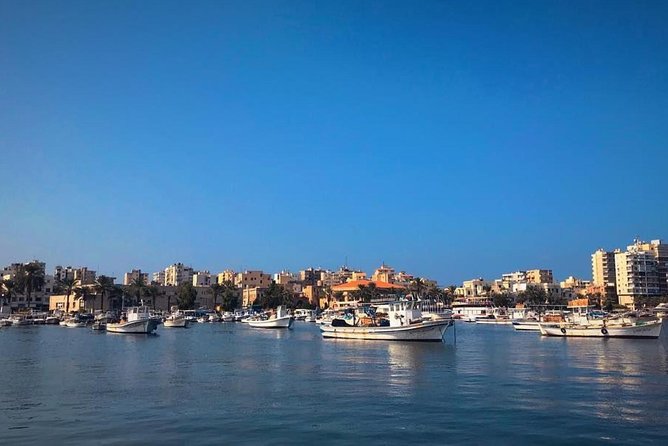
The final stop is El Mina, the coastal town and harbor district of Tripoli. It occupies the site of the old Phoenician city and serves as the port for modern Tripoli.
El Mina includes nine islands. Four have been declared natural reservations to help protect fish breeding and preserve their habitat. The 15-minute stop gives the tour a coastal ending after the enclosed lanes and covered markets of the old center.
This is not a long seaside break. You will not have hours to explore the islands or port on foot. Instead, it provides a useful final perspective on Tripoli’s connection to the Mediterranean and its older Phoenician roots.
The guide can make the long day work
The quality of this experience depends heavily on the guide. Two guides specifically praised for the company are Rita and Pierre. Rita is noted for leading several separate excursions, including Tripoli, a Beirut half-day tour, and Baalbek. Pierre is praised for managing the Tripoli day so well that concern about the long hours did not become a problem.
That detail matters. The schedule has many brief stops, several of them only five minutes. A guide who explains the story clearly and keeps transfers orderly can turn that pace into a useful overview. A weaker guide could make the same schedule feel like a string of hurried photo stops.
The private format gives you some protection against that problem. Only your group participates, and you have a tour leader as well as a professional guide. You should still tell the guide early if you want more time at the Citadel, souks, or mosques, though the full route may limit how much the schedule can change.
Who should book this Tripoli day trip?
I would choose this tour if you are staying in Beirut and want to see Tripoli without arranging your own transport. It suits first-time visitors who want a broad introduction to the city, especially those interested in medieval architecture, urban history, traditional trades, and Lebanese sweets.
It is also a good match for small private groups. You get direct hotel transfers, an air-conditioned vehicle, and a guide focused on your party rather than a large mixed group.
I would think twice if your ideal day means lingering in one souk, spending an hour inside each mosque, or taking a long meal break. The program covers a lot of ground, but several stops are short. Since lunch is not included, plan to ask how and when a meal break will fit into the day.
The free cancellation policy is helpful if your plans are uncertain. You can receive a full refund if you cancel at least 24 hours before the start time. Changes or cancellations made within 24 hours are not accepted for a refund.
Should you book it?
Book this trip if you want efficient, private access to Tripoli’s main historic quarters and prefer to leave the driving to someone else. The best features are the range of sights, the included Citadel admission, the direct Beirut pickup, and the chance to see ordinary commercial spaces such as the tailors’ khan and the souks.
The main compromise is pace. At eight to nine hours, with several five-minute stops, you will get a strong first look rather than a slow study of every building. For most people, that is a fair trade for seeing Tripoli in one organized day, especially with a guide such as Rita or Pierre helping the many historical pieces make sense.
FAQ
Where does the Tripoli tour begin and end?
The tour offers pickup and drop-off directly at your central Beirut address.
How long does the experience last?
The trip lasts approximately eight to nine hours.
Is this a private tour?
Yes. Only your group participates in the private activity.
Is transportation included?
Yes. The tour includes comfortable private transportation in an air-conditioned vehicle.
Is a professional guide included?
Yes. A tour leader and professional guide are included.
Are entrance fees included?
The Citadel Saint Gilles admission fee is included. The other listed stops are shown as free admission.
Is lunch included?
No. Lunch is not included in the tour price.
What is the price?
The listed price is $100 per person, and group discounts are offered.
Can I cancel for a full refund?
Yes, if you cancel at least 24 hours before the experience start time. Cancellations made less than 24 hours in advance are not refunded.
Newest Beirut reviews
- Wine Tasting Tour★ 5.0 · 2 reviews
- Journey Through Time: Half-Day Private Tour to Baalbek★ 5.0 · 3 reviews
- Lebanon’s Treasures: Jeita Grotto and Harissa Private Tour★ 5.0 · 2 reviews
- Traveling Spoon Lebanese Mezze Private Online Cooking Class★ 5.0 · 4 reviews
- Wine Tasting and Culture★ 5.0 · 3 reviews
- Small Group Tour to Baalbek, Anjar & Ksara with Hotel pickup★ 5.0 · 2 reviews
- Small Group Tours to Jeita Grotto and Byblos with tickets★ 5.0 · 3 reviews
- Small-Group Tour with Lunch to Baalbek, Anjar and Ksara★ 5.0 · 3 reviews
Tripoli Tours, compared.
PRIVATE city Tour of authentic Tripoli and vibrant Batroun
Read our review →
Guided Small-Group Tour to Tripoli and Batroun with Lunch
Read our review →
Full day Tripoli private great guide/all-in + rustic meal
Read our review →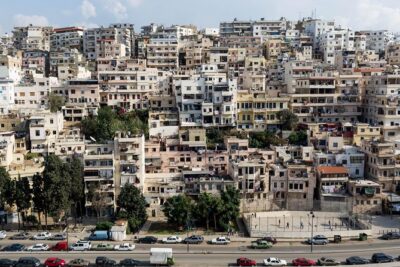
Private Full-Day Tour to Byblos and Tripoli from Beirut
Read our review →Browse the lists this tour appears in