Review · TOURS
Beirut Walking Tour – Discover Beirut by foot
Beirut reveals itself best on foot. This three-hour walk links the waterfront at Zaitunay Bay with Roman ruins, Ottoman-era monuments, churches, mosques, rebuilt shopping streets, and neighborhoods shaped by war and renewal. You get a useful first look at central Beirut without having to plan every stop yourself.
I like the small maximum of 15 people, which should give you a better chance to ask questions and keep up with the guide. I also like the route’s variety: one moment you are beside ancient Roman baths, and the next you are looking at a modern mosque, a restored square, or street art in Achrafieh and Gemmayzeh.
The main drawback is the pace. Eleven stops in about three hours means some visits are brief, often around 15 minutes. You should also expect a fair amount of walking, including the St. Nicolas Stairs, and interior access to religious buildings is not clearly guaranteed.
In This Review
- Key points to know before booking
- Starting at Zaitunay Bay at 5:00 pm
- Martyrs’ Square and the city’s difficult memory
- The Mohammad Al-Amin Mosque and Al-Omari Grand Mosque
- Saint George Cathedral and the old Christian quarter
- Place de l’Étoile and the four-faced clock
- Roman Baths: ancient Berytus in the open air
- Beirut Souks and the rebuilt commercial center
- St. Nicolas Stairs and the route into Achrafieh
- Samir Kassir Square and Beirut Municipality
- What the $30 price really buys you
- Practical advice for making the walk comfortable
- Who will get the most from this Beirut walk?
- Should you book the Beirut Walking Tour?
- FAQ
- Where does the Beirut Walking Tour start?
- What time does the tour begin?
- Where does the tour finish?
- How long does the walking tour last?
- How much does the tour cost?
- How large is the tour group?
- Which landmarks are included?
- Is the tour available with a mobile ticket?
- Can I cancel for a full refund?
Key points to know before booking
- Starts at Zaitunay Bay at 5:00 pm: The waterfront meeting point gives you an easy visual beginning and places you near Beirut’s central districts.
- Covers Beirut’s major downtown landmarks: The route includes Martyrs’ Square, the Mohammad Al-Amin Mosque, Saint George Cathedral, Place de l’Étoile, the Roman Baths, and Beirut Souks.
- Small-group format: The maximum group size is 15, useful for questions and closer contact with the guide.
- Strong historical range: You move from Roman Berytus and medieval religious buildings to civil-war damage, reconstruction, and modern city life.
- Includes a stair climb: St. Nicolas Stairs are part of the route, so comfortable shoes matter.
- Good orientation for a first visit: The walk finishes at Beirut Municipality, giving you a broad sense of central Beirut before exploring further on your own.
Starting at Zaitunay Bay at 5:00 pm
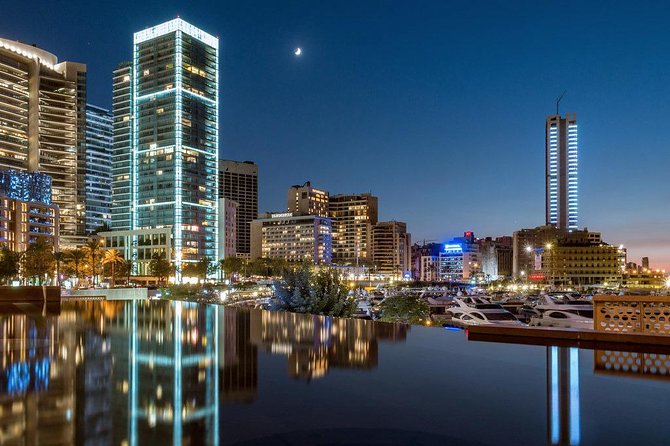
The tour begins at Zaytouna Bay, also written as Zaitunay Bay, at Beirut Marina. This modern waterfront promenade has restaurants, shops, and leisure spaces, making it a simple place to find the group before the walk begins.
Starting here is a smart choice. Beirut can feel scattered when you first arrive, with the sea, downtown, Achrafieh, Gemmayzeh, and residential areas all pulling your attention in different directions. The waterfront gives you a clear reference point before you head inland.
The late afternoon start should also make the walk more pleasant than a midday departure. Still, the tour is listed as approximately three hours, so you may finish after sunset depending on the pace and the amount of time spent at each stop.
Your guide is an important part of the experience. Georgette has led this walk and is praised for giving clear explanations while moving through several districts. A good guide matters here because Beirut’s buildings often carry several layers of meaning, and a quick look does not always explain what you are seeing.
Other guided walks through Beirut:
- PRIVATE Beirut Historical Walking Half Day Tour
★ 5.0 · 27 reviews - Beirut Full Day Walking Tour
★ 5.0 · 14 reviews - Beirut: Private Walking Tour With A Guide (Private tour)
★ 4.9 · 9 reviews
Martyrs’ Square and the city’s difficult memory
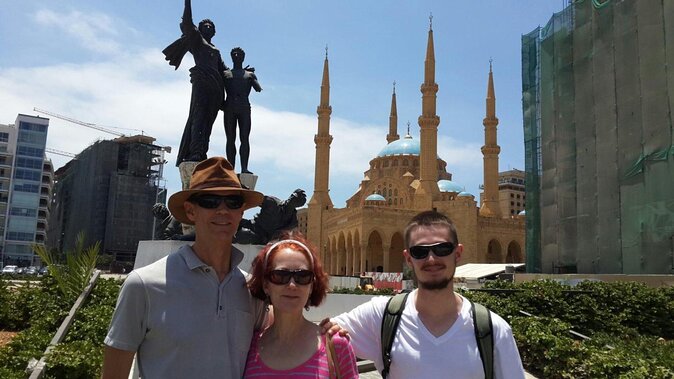
From the waterfront, the walk reaches Martyrs’ Square, one of Beirut’s most important public spaces. The square was once known as Al Burj or Place des Cannons, and its current name recalls the executions of Lebanese nationalists by the Ottoman authorities on May 6, 1916.
This is not simply a photo stop. The square helps explain Lebanese national identity and the way Beirut’s public spaces carry political memory. It has also suffered damage and change over time, so the guide’s context can add much more than a quick visit on your own.
The planned stop is about 15 minutes. That is enough to understand the site and take photographs, but probably not enough for a long discussion of every phase of its history. If this is a place you particularly care about, note the guide’s explanation and return later for a slower look.
The Mohammad Al-Amin Mosque and Al-Omari Grand Mosque
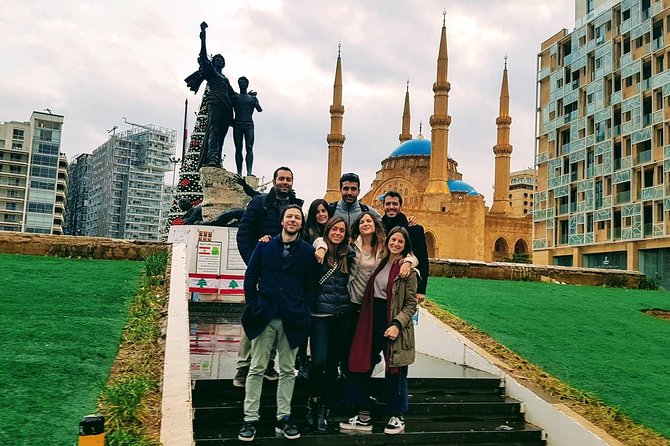
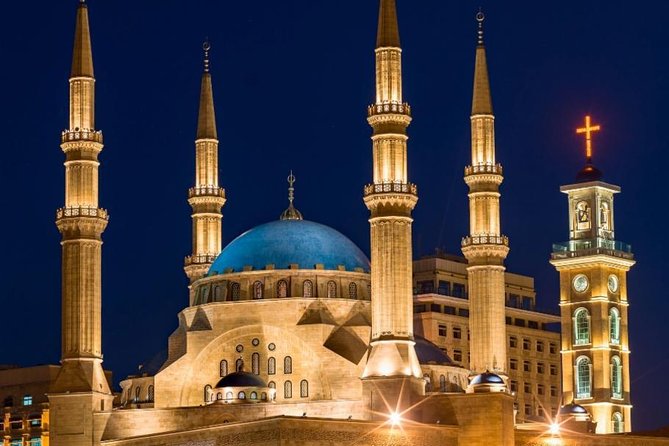
The Mohammad Al-Amin Mosque is one of the most recognizable buildings in central Beirut. Often called the Blue Mosque, it opened in 2008 and has four minarets rising about 65 meters. Its amber-colored exterior, pale blue tiled domes, and tall arches give it a powerful presence beside Martyrs’ Square.
I like this part of the route because the mosque is visually striking but also useful for understanding modern Beirut. Its scale and recent construction contrast sharply with the older religious buildings nearby. You are not looking at one single style of Lebanese architecture. You are seeing different periods placed close together.
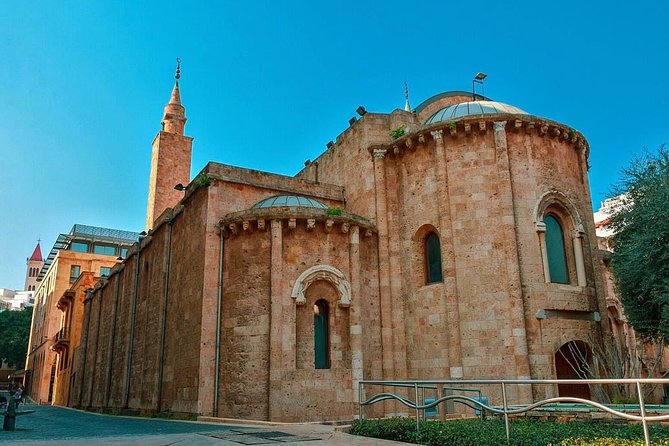
The route also includes the Al-Omari Grand Mosque. Its story reaches back to 635 AD, when it was built during the age of Omar Bin El Khattab. Crusaders later converted it into the Church of Saint John, and the Mamluks turned it back into a mosque in 1291.
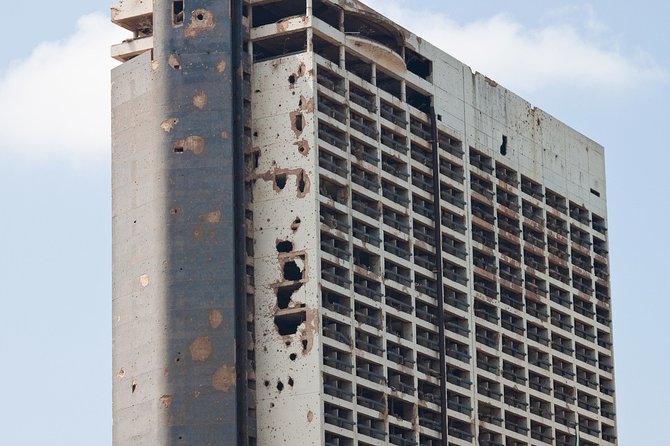
The building was damaged during the Lebanese Civil War and restored in 2004. That sequence gives you a compact lesson in Beirut’s past: religious change, political power, conflict, and repair are all visible in one place.
The tour information does not promise entry into either mosque. Dress respectfully around religious sites, and understand that the walk may focus on the exterior and surrounding history.
Saint George Cathedral and the old Christian quarter
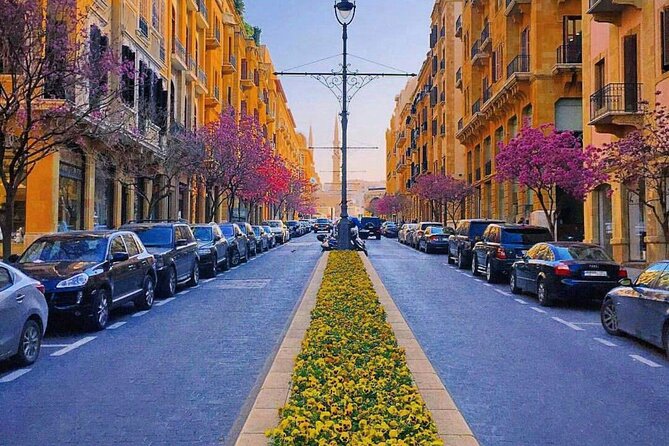
The Greek Orthodox Cathedral of Saint George sits in the heart of downtown Beirut. It is the city’s oldest church and one of the oldest in the region, with a Christian temple on this site dating to the mid-sixth century.
The cathedral is closely linked with Beirut’s famous Law School, a reminder that the city was once an important center for legal study in the eastern Roman world. That detail makes the stop more than a church visit. It connects the religious building to the city’s role as a place of education and law.
At about 15 minutes, this stop is short but well placed. The cathedral follows the mosques, allowing you to compare religious architecture and institutions within a compact part of the city. If you want detailed interior viewing, ask the guide what is possible on the day.
A few more trips out of Beirut worth a look
- Guided Small-Group Tour to Baalbek, Anjar and Ksara with Lunch
★ 5.0 · 511 reviews - Guided Small-Group Tour to Jeita, Harissa, Byblos with Lunch
★ 5.0 · 361 reviews - Paragliding Trip Over Lebanon – Jounieh Bay
★ 5.0 · 257 reviews - First Paragliding Club in Lebanon – Since 1992
★ 5.0 · 193 reviews
Place de l’Étoile and the four-faced clock
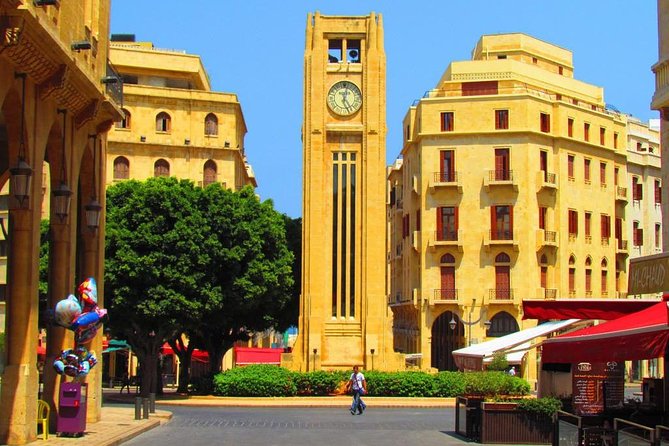
Place de l’Étoile, or Nejme Square, is the central square of Beirut’s downtown area. The Lebanese Parliament and related buildings are here, along with two cathedrals, a museum, cafes, and restaurants.
The square is best known for its 1930 four-faced Rolex clock. Its surrounding architecture gives the area a formal, European-influenced character, while the nearby religious and civic buildings show how many functions were gathered into the old center.
This is another quick stop, but it helps you understand the layout of central Beirut. The square is not an isolated monument. It is part of a civic core where government, worship, commerce, and public life meet.
The presence of the parliament also means the area has a political importance beyond its appearance. You should follow the guide’s directions about where to stand and what can be photographed.
Roman Baths: ancient Berytus in the open air
The Roman Baths are one of the most rewarding stops for anyone who likes archaeology but does not want to spend an entire day in a museum. The baths were discovered in 1968 and 1969 and underwent major renovation in the mid-1990s.
Roman Berytus had four major bath complexes. The first was created in the early first century under Augustus. A major earthquake in 551 AD destroyed the baths, but the remains still show the scale and planning of ancient city life.
I like the way this stop changes the rhythm of the tour. After churches, mosques, and formal squares, you are suddenly looking at the physical remains of daily Roman life. The site is outdoors and easy to view during a walking route.
One of the bath areas is used for artistic performances and concerts. That modern use is fitting: the site is not sealed away from city life but remains part of Beirut’s public culture.
Again, allow for a short visit rather than a full archaeological lesson. The guide can point out the main features, but anyone wanting detailed Roman history should plan a separate return visit.
Beirut Souks and the rebuilt commercial center
Beirut Souks is a major shopping and leisure district in the city center. It includes more than 200 shops, 25 restaurants and cafes, an entertainment center, and a cinema complex.
At first glance, this may seem like a less historic stop than the Roman Baths or Place de l’Étoile. It is still useful. The souks show how Beirut’s commercial center has been rebuilt and adapted for present-day life. The contrast with nearby damaged or ancient sites makes the city’s changes easier to understand.
The stop can also be practical. You may want to note a cafe or restaurant for later, especially since the walk ends at Beirut Municipality rather than returning to the starting point.
Do not expect a traditional market experience based on the information provided. Beirut Souks is a modern commercial district, so its value lies in seeing the current downtown economy and urban design.
St. Nicolas Stairs and the route into Achrafieh
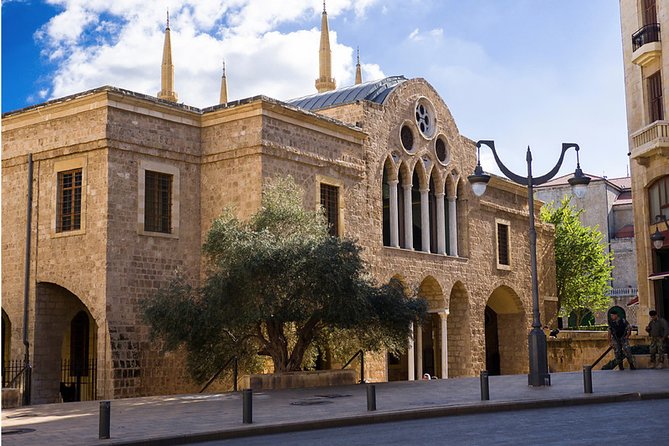
The tour continues toward St. Nicolas Stairs, described as the longest stairway in the Middle East. This is the point where sturdy shoes become especially important.
A stairway can tell you something about Beirut that a monument cannot. It connects streets and neighborhoods through the city’s natural slope, and it gives the walk a more local, physical character. You are no longer moving only between formal downtown sights.
The route also reaches Saifi Village, an upscale residential area on the southeastern edge of Centre Ville. From there, the walk has included streets in Achrafieh and Gemmayzeh, along with buildings, monuments, and street graffiti.
That neighborhood section is one of the walk’s strongest features. It broadens the experience beyond the most photographed landmarks. You get a sense of Beirut as a lived-in city, with residential streets and creative details alongside restored commercial areas.
The exact balance between downtown and these neighborhoods may depend on the guide and the pace. The published route gives each listed stop about 15 minutes, so you should be ready for an overview rather than a long neighborhood wander.
Samir Kassir Square and Beirut Municipality
The walk returns toward the Bourj area by way of the Al-Nahar building and Samir Kassir Garden. It then reaches Samir Kassir Square and its statue.
This part of the route adds a modern civic and cultural layer to the tour. The square and statue are connected with Samir Kassir, a prominent Lebanese journalist and public intellectual. The stop gives the walk a more recent focus after its Roman, Ottoman, medieval, and religious landmarks.
The final destination is Beirut Municipality, where the tour ends. This is useful for orientation, but it also means you should not assume you will finish back at Zaitunay Bay. Check your route onward before setting out, particularly if you have dinner plans or a timed booking.
What the $30 price really buys you
At $30 per person, this tour is priced as an accessible introduction rather than a luxury experience. The admission cost at each listed stop is free, so the value comes from the guide, the route planning, and the historical links between places.
I think the price is fair if you are new to Beirut and want structure. You could walk between many of these areas on your own, but you might miss the significance of the Al-Omari Mosque, the connection between Saint George Cathedral and the old Law School, or the story behind Martyrs’ Square.
The small group improves the value. With a maximum of 15 people, the guide can usually keep the group together more easily than on a large coach-style city tour. You also have a better chance to ask about a building, a neighborhood, or a place to return to later.
The tradeoff is depth. Eleven stops in approximately three hours leaves little time at each one. I would book this for orientation and context, not as a substitute for a full museum visit or a slow architectural study.
Practical advice for making the walk comfortable
Wear shoes suitable for several hours of city walking and stairs. The route includes St. Nicolas Stairs and moves through multiple districts, so light footwear is a better choice than anything stiff or slippery.
The meeting point is Zaytouna Bay at Beirut Marina, listed by the map code WF2X+V7W. The end point is Beirut Municipality, listed as VGX4+67F. Save both locations before leaving your accommodation.
The tour has a mobile ticket, and confirmation is sent at booking. It is near public transportation, and most people can participate according to the supplied details.
The cancellation policy allows a full refund if you cancel at least 24 hours before the 5:00 pm start. Changes or cancellations within 24 hours are not accepted for a refund. The experience also requires a minimum number of participants, so a cancellation by the operator may result in another date, another experience, or a full refund.
Who will get the most from this Beirut walk?
I would recommend it most strongly for a first visit. You will quickly learn where central Beirut’s main districts sit in relation to one another, then you can return to the places that caught your attention.
It also suits anyone who prefers history explained in place. The route connects Roman remains, churches, mosques, public squares, shopping areas, and modern memorials without requiring you to spend your first day buried in guidebooks.
The walk is less suited to you if you want long visits inside monuments, extensive shopping time, or a relaxed pace at every stop. The schedule is full, and the stair section may be tiring for anyone who has difficulty with prolonged walking.
Georgette’s warm, informative guiding style is a particular plus if she is leading your departure. Her route has included Achrafieh, Gemmayzeh, the corniche, the souks, and central landmarks, giving the walk a useful mix of famous buildings and less formal city streets.
Should you book the Beirut Walking Tour?
Book it if you want a reasonably priced introduction to Beirut with a guide, a small group, and a strong mix of ancient and modern sights. The best parts are the range of places covered, the historical connections, and the chance to see ordinary streets between the major monuments.
Skip it if you prefer to spend an hour at each site or need a low-effort route with minimal stairs. For most first-time visitors who can manage three hours of walking, this is a practical way to get your bearings and decide where Beirut deserves more of your time.
FAQ
Where does the Beirut Walking Tour start?
The tour starts at Zaytouna Bay, Beirut Marina, at the location listed as WF2X+V7W Beirut Marina, Bayrut, Lebanon.
What time does the tour begin?
The stated start time is 5:00 pm.
Where does the tour finish?
The tour ends at the Municipality of Beirut, listed as VGX4+67F, Beirut, Lebanon.
How long does the walking tour last?
The experience lasts approximately three hours.
How much does the tour cost?
The listed price is $30 per person.
How large is the tour group?
The maximum group size is 15 participants.
Which landmarks are included?
The route includes Zaitunay Bay, Martyrs’ Square, the Mohammad Al-Amin Mosque, Al-Omari Grand Mosque, Saint George Cathedral, Place de l’Étoile, the Roman Baths, Beirut Souks, St. Nicolas Stairs, Saifi Village, Samir Kassir Square, and Beirut Municipality.
Is the tour available with a mobile ticket?
Yes. A mobile ticket is provided, and confirmation is received at the time of booking.
Can I cancel for a full refund?
Yes, if you cancel at least 24 hours before the local start time. Cancellations or changes made less than 24 hours before the start are not refunded.
Newest Beirut reviews
- Wine Tasting Tour★ 5.0 · 2 reviews
- Journey Through Time: Half-Day Private Tour to Baalbek★ 5.0 · 3 reviews
- Lebanon’s Treasures: Jeita Grotto and Harissa Private Tour★ 5.0 · 2 reviews
- Traveling Spoon Lebanese Mezze Private Online Cooking Class★ 5.0 · 4 reviews
- Wine Tasting and Culture★ 5.0 · 3 reviews
- Small Group Tour to Baalbek, Anjar & Ksara with Hotel pickup★ 5.0 · 2 reviews
- Small Group Tours to Jeita Grotto and Byblos with tickets★ 5.0 · 3 reviews
- Small-Group Tour with Lunch to Baalbek, Anjar and Ksara★ 5.0 · 3 reviews
Tours, compared.

Guided Small-Group Tour to Baalbek, Anjar and Ksara with Lunch
Read our review →
Guided Small-Group Tour to Jeita, Harissa, Byblos with Lunch
Read our review →
Private Anjar and Baalbek Tour from Beirut with Departure Ticket
Read our review →
Guided Private Full Day Tour to Baalbek, Anjar and Chateau Ksara
Read our review →
Semi-Private Tour to Jeita Grotto, Harissa & Byblos with Lunch
Read our review →
PRIVATE city Tour of authentic Tripoli and vibrant Batroun
Read our review →